The Shocking Truth: When Did the First Soft and Hard Shells in Animals Form?
 Befrey
When did the first soft and hard shells in animals form, according to scientists? The short answer is fascinating: soft, non-mineralized coverings appeared first, likely more than 555 million years ago, while true hard, mineralized shells emerged slightly later, somewhere between 550 and 520 million years ago. This single question opens a door into one of the most dramatic transformations in the history of life on Earth. Shell formation, or biomineralization, didn’t happen overnight. It was a slow, layered process shaped by chemistry, predation, and pure survival instinct. Scientists have spent decades digging through ancient rock layers to pin down exactly when squishy, defenseless creatures first started building armor. What they found rewrites the story of animal evolution itself.
What Scientists Actually Mean by “Soft” and “Hard” Shells
Before diving into dates, it helps to understand what researchers actually mean when they talk about shells. A “soft shell” isn’t rubbery or bendy in the way we might picture a soft-shell crab. It refers to an organic, non-mineralized covering, usually made from proteins or chitin-like material, that offered structure without true biological armor. A “hard shell,” by contrast, is biomineralized. That means the animal actively pulls minerals like calcium carbonate or calcium phosphate from seawater and deposits them into a rigid, crystalline structure. This distinction matters enormously to paleontologists. Soft coverings rarely fossilize well, so evidence for them is rare and precious. Hard shells, on the other hand, preserve beautifully, which is exactly why the fossil record explodes with shelled creatures the moment biomineralization becomes common. Understanding this difference is the key to understanding why scientists give two separate timelines instead of one single date.
The Evolution of Shells in Animals: From Bare Skin to Body Armor
The evolution of shells in animals didn’t begin with a shell at all. It began with bare, soft-bodied organisms drifting and crawling across ancient seafloors with absolutely no protection whatsoever. For hundreds of millions of years, life on Earth consisted almost entirely of single cells, simple mats of microbes, and later, soft multicellular creatures with no rigid parts. Stromatolites, layered structures built by microbial communities, date back an astonishing 3.5 billion years, though these were microbial mats rather than shelled animals. The real shift toward complex animal bodies took much longer to arrive. It wasn’t until the late Ediacaran Period, roughly 580 million years ago, that the ocean floor saw a proliferation of strange, soft-bodied creatures shaped like fronds, ribbons, and quilted mats. These organisms lacked anything resembling a modern shell, but they represented the biological experimentation ground where shell evolution would eventually take root. Interestingly, sponges are considered among the first reef-builders on Earth thanks to their early hard skeletal structures, showing that some form of structural rigidity was already being tested even before true shells appeared. This slow build-up matters because it proves shell evolution wasn’t a single invention. It was a gradual accumulation of small biological tricks, refined over tens of millions of years, until one lineage finally cracked the code for permanent armor. Smithsonian National Museum of Natural History + 2

Ediacaran Period Soft-Bodied Organisms: Life Before Shells Existed
To understand Ediacaran period soft-bodied organisms is to understand the calm before the storm. This period, stretching from roughly 635 to 541 million years ago, was dominated by creatures that had no bones, no claws, and critically, no hard shells. Most Ediacaran animals were flat, soft, and passive, absorbing nutrients or grazing gently on microbial mats without needing to fight anyone off. Predation as we understand it today was extremely rare or possibly absent for much of this period, which meant there was little evolutionary pressure to build armor. Life was, in a very real sense, safer back then, at least from other animals. That safety wouldn’t last forever, and the fossil record shows early hints of change creeping in during the final tens of millions of years of the Ediacaran. One creature in particular stands out as the missing link between total softness and the beginning of shell-like protection.
Kimberella and the First Whisper of a Shell
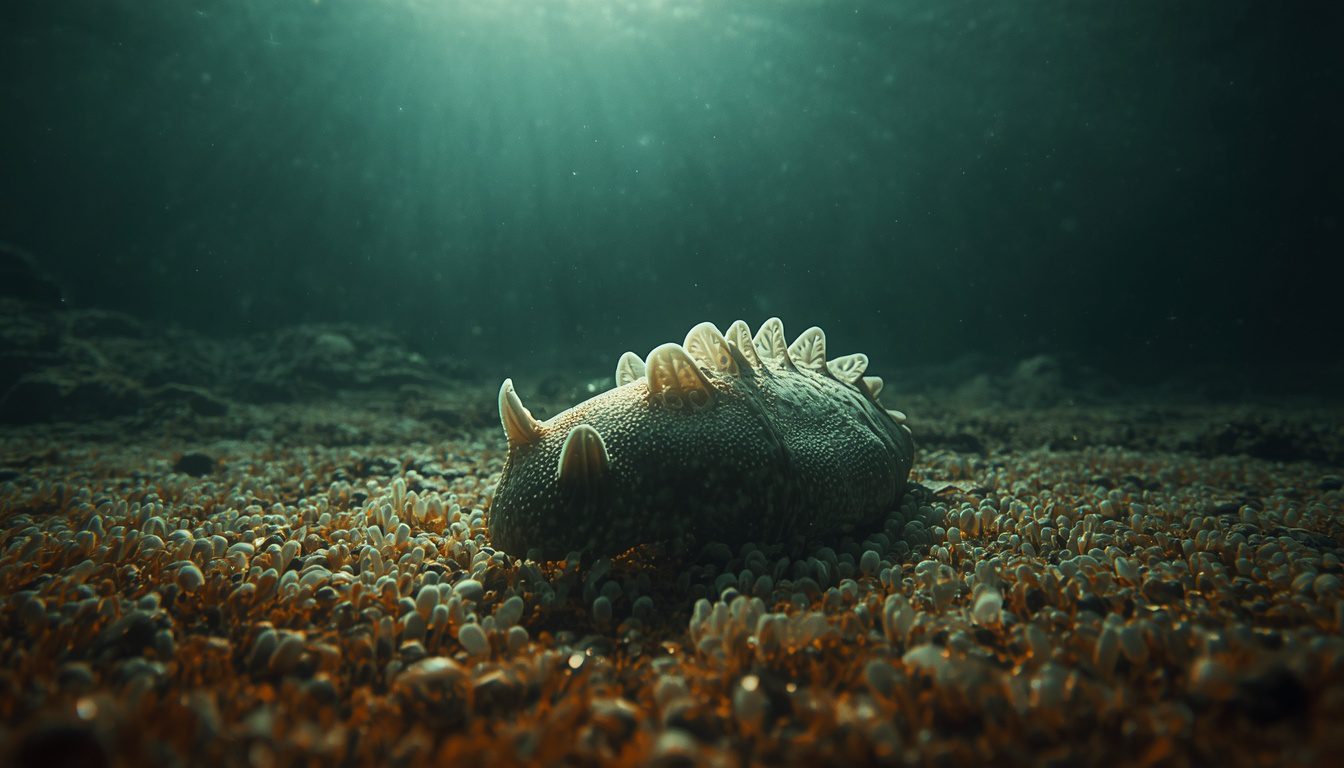
Kimberella is arguably the single most important fossil for answering when soft shells first appeared. This slug-like, oval-bodied creature lived roughly 555.3 million years ago, based on precise uranium-lead zircon dating of volcanic ash layers surrounding its fossils in Russia’s White Sea region. Unlike its soft, formless neighbors, Kimberella carried something remarkable: a tough, non-mineralized dorsal covering. Researchers describe this structure as a stiffened, sclerotized covering likely made from organic material similar to chitin or tough proteinaceous compounds, rather than true calcium carbonate. This wasn’t a shell in the modern sense, but it was clearly protective, clearly structural, and clearly a precursor to what would come next. Some paleontologists have gone so far as to describe Kimberella as possessing a “soft shell and big foot,” positioning it as a possible early relative of modern molluscs. Its classification remains debated among scientists, with some calling it a stem-group mollusc and others a more general bilaterian animal. Regardless of its exact family tree, Kimberella proves that soft shells existed by at least 555 million years ago, making it one of the oldest documented examples of shell-like protection in the animal kingdom. ResearchGate + 2
Biomineralization in Early Animals: How Soft Tissue Turned to Stone
Biomineralization in early animals is where the story shifts from soft protection to genuine hard armor, and the mechanism behind it is stranger than most people expect. Scientists once assumed animals built mineral shells the way a crystal grows in a lab, adding ions one by one from surrounding water. Recent research proved this wrong in a beautiful way. Researchers discovered that when carbonate skeletons first evolved more than 500 million years ago, wildly different groups of animals independently converged on the same strange method of building them. Instead of forming crystals ion by ion, these early animals used amorphous, non-crystalline nanoparticles as their basic building blocks, a process now called crystallization by particle attachment. This technique shows up today in creatures as different as echinoderms, mollusks, and corals, all of which still build calcium carbonate shells or skeletons this same unusual way. The fact that so many unrelated animal groups landed on the exact same biological trick suggests it must offer a powerful advantage, possibly related to how quickly or efficiently an animal can grow its armor. This shared method also gives scientists a reliable fingerprint they can search for in ancient fossils, helping them trace biomineralization back to its earliest possible appearance in the fossil record. Futurity + 2

The Cambrian Explosion and Hard Shell Evolution: Nature’s Turning Point
The Cambrian explosion and hard shell evolution are so tightly linked that most textbooks treat them as a single event, even though the reality is more nuanced. Hard shells didn’t wait for the Cambrian Period to begin; they got a head start slightly earlier, in the very end of the Ediacaran. Researchers studying ancient reef fossils in Namibia found that Cloudina, a small filter-feeding creature, built the oldest known animal-made reef roughly 548 million years ago. This matters enormously because Cloudina is considered the first animal known to have possessed a true hard skeleton, in this case a mineralized outer shell. That discovery pushed the origin of hard shells back significantly earlier than scientists previously believed, showing that important evolutionary developments were already underway millions of years before the Cambrian explosion officially began. Once the Cambrian Period truly kicked off around 541 million years ago, hard shells exploded in diversity almost overnight in geological terms. Scientists studying this rapid burst describe it as a moment when the ancestors of nearly every modern animal group began experimenting seriously with skeletons and shells around 530 million years ago. Some geochemists even found direct evidence linking this shift to ocean chemistry, suggesting a sudden surge in oceanic calcium levels, possibly triggered by volcanic activity along mid-ocean ridges, may have pushed animals toward building shells as a way to manage the excess mineral. Whatever the exact trigger, the timing is unmistakable: hard shells transformed from a rare novelty into a dominant survival strategy within an extraordinarily short evolutionary window. The Japan Times + 4
Small Shelly Fossils: The Tiny Clues That Rewrote Earth’s History
Small shelly fossils are some of the most underrated treasures in all of paleontology, and they hold crucial clues about exactly how fast hard shells spread across the animal kingdom. These fossils are exactly what they sound like: tiny, often millimeter-sized shells, spines, plates, and armor fragments scattered through early Cambrian rock. Researchers studying one especially well-preserved specimen described fossils of shelled ocean creatures dating to about 520 million years ago, noting that these animals were considerably larger than previously believed. What’s especially striking is the complexity of these early shells. Scientists analyzing the fossil Cambrothyca found it was covered with complex armor built from hundreds of separate, tiny, jar-shaped pieces, rather than one simple solid shell. This tells researchers that shell-building wasn’t crude trial and error; it was already remarkably sophisticated within just a few million years of appearing. Paleontologists explain that these small shelly fossils represent some of the very first direct evidence of biomineralization and true skeleton formation in animals, predating even the large, spectacular fossils typically associated with the Cambrian explosion. In many ways, these tiny fragments are more scientifically valuable than large dramatic fossils because they capture the exact moment shell evolution shifted from rare experiment to widespread biological strategy. Phys.org + 2
The Predator-Prey Arms Race in Shell Evolution: Why Armor Became Essential
The predator-prey arms race in shell evolution offers perhaps the most emotionally compelling explanation for why hard shells appeared when they did. For most of the Ediacaran Period, life was relatively peaceful, but that peace shattered as predation intensified heading into the Cambrian. Scientists studying this shift describe it using a term borrowed from literature: the Red Queen hypothesis. Under this model, prey animals constantly tried to build better hard defenses like shells and spines, while predators simultaneously evolved mineralized mouthparts and new hunting strategies to break through that armor. This wasn’t a one-time event but an ongoing evolutionary tug-of-war. Direct physical evidence for this arms race came from an extraordinary discovery involving tiny fossilized shells belonging to a creature called Lapworthella fasciculata. Researchers found over 200 shells from this species, dated to roughly 517 million years old, showing distinct holes made by an unknown hole-punching predator, offering the oldest confirmed physical proof of predator-prey escalation ever discovered. Scientists involved in the research stated plainly that predator-prey interactions are frequently cited as a major driver of the Cambrian explosion, particularly regarding the rapid rise in diversity and abundance of shell-building organisms. Similar patterns show up in trilobite fossils too, where researchers studying ancient shale deposits noted that predator-prey dynamics sparked an evolutionary arms race that promoted the spread of biomineralized exoskeletons, shells, and the first shell-crushing predators. Put simply, animals didn’t evolve hard shells purely by accident. Many of them built armor because the alternative was getting eaten, and that pressure accelerated shell evolution at a pace unmatched anywhere else in Earth’s history. Palaeontologyonline + 3
Why Calcium Carbonate Became Nature’s Favorite Shell Material
Once the question of when did the first soft and hard shells in animals form starts to make sense, a natural follow-up question emerges: why calcium carbonate specifically? Ocean water during the late Ediacaran and early Cambrian happened to be extremely rich in dissolved calcium, largely due to increased volcanic and tectonic activity reshaping the seafloor. This chemical abundance made calcium carbonate an unusually accessible building material for early animals experimenting with mineralized structures. Some researchers even proposed that animals initially built shells not for defense at all, but simply to purge dangerous excess calcium from their bodies, since too much internal calcium can be toxic to soft tissue. Over time, this waste-management strategy likely doubled as an accidental defensive upgrade, and evolution rewarded any creature that benefited from the side effect. Rising oxygen levels around the same period also played a supporting role, since building and maintaining a mineralized shell requires significant metabolic energy that simple, low-oxygen organisms simply couldn’t afford. Together, ocean chemistry, oxygen availability, and predation pressure created the perfect storm for hard shells to spread rapidly once the underlying biological machinery existed. It’s a rare case in evolutionary biology where multiple unrelated pressures converged to push life in the exact same direction at almost the exact same time.
What Ancient Shells Teach Us About Life on Earth Today
The story of ancient shell evolution isn’t just a historical curiosity; it echoes directly into the natural world surrounding us right now. Every clam, snail, coral, and sea urchin alive today still relies on biological machinery first refined more than 500 million years ago during that original Cambrian shell revolution. Modern marine biologists studying ocean acidification actually look back at these ancient events to understand how shelled animals might respond to changing ocean chemistry today. If a sudden calcium surge helped trigger the original shell boom, then falling calcium availability or rising acidity could theoretically threaten shell-forming species in the modern era. This ancient arms race between predator and prey also never truly ended; it simply evolved into the crab claws, drilling snails, and shell-crushing fish we see hunting in oceans today. Understanding when shells first formed gives scientists a genuine evolutionary baseline, a starting point they can compare against modern stressors like warming seas and pollution. In many ways, every shell washed up on a beach today is a tiny, living monument to one of the most important survival innovations life on Earth has ever produced.
How Multicellular Organisms Developed in Prehistoric Times
Prehistory Cambrian Explosion
Proterozoic: the development of eukaryotic cells, the first multicellular organisms
Summary
Scientists generally agree that soft, non-mineralized shells appeared first, with Kimberella providing strong evidence dating to roughly 555 million years ago during the late Ediacaran Period. True hard, biomineralized shells followed closely behind, with Cloudina offering solid proof of mineralized armor by around 548 million years ago, well before the Cambrian Period officially began. Once the Cambrian explosion kicked into gear around 541 million years ago, hard shells diversified explosively, driven by a combination of ocean chemistry changes, rising oxygen levels, and an intense predator-prey arms race. Small shelly fossils from this era, some dated to 520 and 517 million years ago, show just how quickly shell complexity and predation pressure escalated. Far from being a random accident, shell evolution represents one of the most tightly interconnected chains of cause and effect in all of natural history.
Frequently Asked Questions
Did soft shells or hard shells evolve first in animals?
Soft shells evolved first. Fossil evidence from creatures like Kimberella shows non-mineralized, organic coverings existing around 555 million years ago, before true biomineralized hard shells appeared.
What was the very first animal known to have a hard shell?
Cloudina is widely regarded as the earliest known animal with a genuinely hard, mineralized skeleton, with fossil evidence dating back roughly 548 million years.
Why did the Cambrian explosion cause so many animals to develop shells?
A combination of rising ocean calcium levels, increasing oxygen availability, and intense predator-prey competition pushed many unrelated animal groups to independently evolve hard shells within a relatively short evolutionary window.
What is biomineralization, exactly?
Biomineralization is the biological process by which animals extract minerals like calcium carbonate from seawater and deposit them into structured, hardened tissue such as shells, skeletons, or spines.
How do scientists know exactly how old these ancient shell fossils are?
Researchers typically use radiometric dating techniques, such as uranium-lead dating of volcanic ash layers found near fossil beds, to establish extremely precise ages for ancient shell-bearing organisms.
Call To Action
If this journey through 500 million years of evolutionary history fascinated you, don’t stop here. Explore more deep-dive science breakdowns, share this article with a fellow science lover, and drop a comment below with your own theory on why nature decided armor was worth the effort. Curiosity built shells millions of years ago, and it can keep building knowledge today too.