Befrey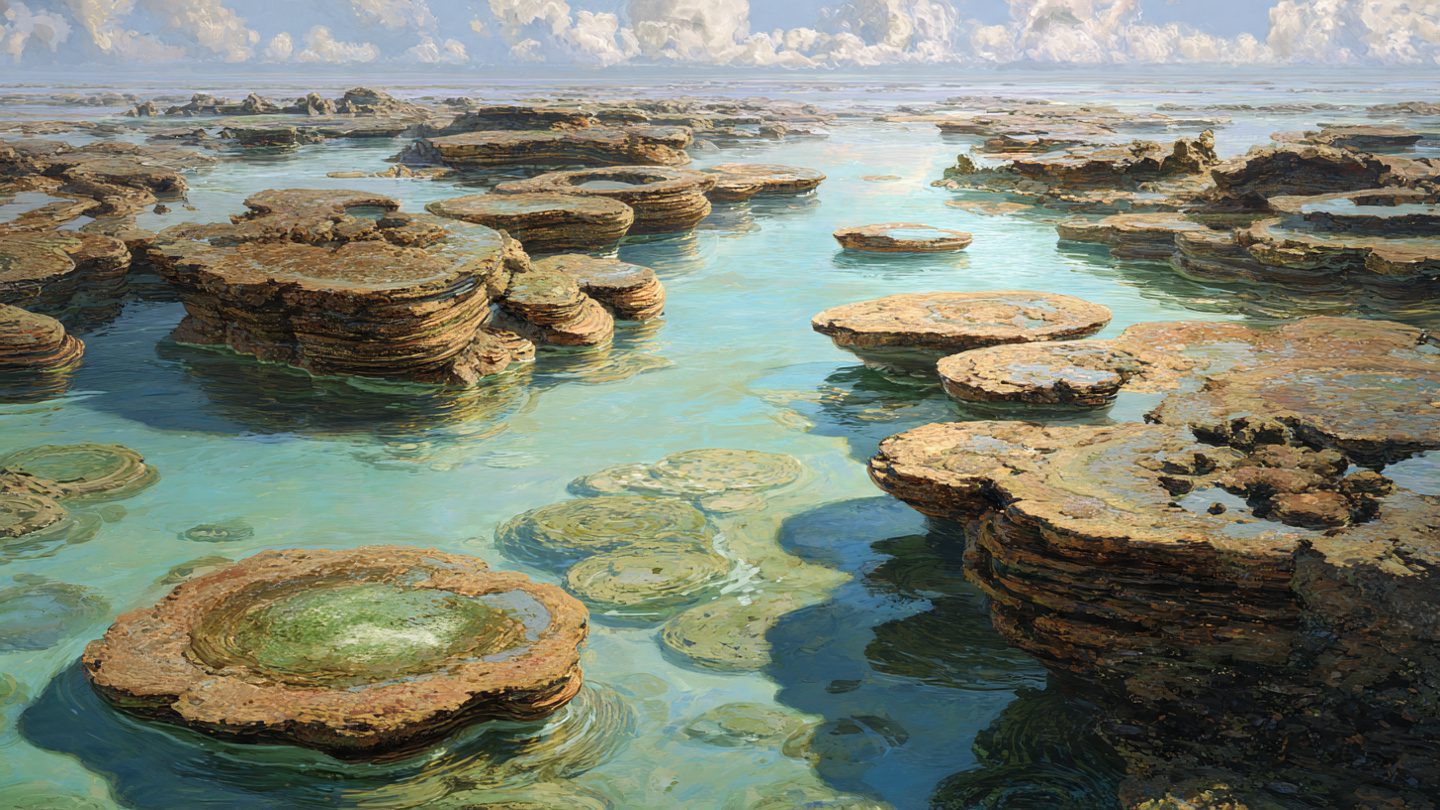
Introduction: The First Spark of Life
The Precambrian Mystery When Life First Started on Earth explores one of the most profound questions in science—how life began from lifeless matter. This era spans nearly 90% of Earth’s history, yet it remains one of the least understood.
In cinematic visualizations, this mystery unfolds in dramatic sequences. A hostile planet slowly transforms. Oceans form. Chemistry becomes biology. The silence of a lifeless world is broken by the first microscopic organisms.
This is not just a scientific story. It is the origin of everything alive today.
Early Earth conditions and hostile environment
The early Earth was a brutal place. Volcanic eruptions dominated the landscape. The atmosphere was toxic, filled with gases like methane and ammonia.
Temperatures fluctuated wildly. Meteor impacts were frequent. The surface was unstable and dangerous.
In video reconstructions, this environment appears chaotic—boiling oceans, lightning storms, and thick clouds covering the sky. These extreme conditions, however, were essential. They created the chemical building blocks necessary for life.
Primordial soup theory and chemical evolution
One of the most widely discussed ideas is the primordial soup theory. It suggests that life began in a mixture of water and simple organic compounds.
Energy sources like lightning or ultraviolet radiation triggered chemical reactions. These reactions formed increasingly complex molecules.
Visual sequences often show glowing oceans filled with organic material. Molecules collide, combine, and evolve. Over time, these interactions lead to the formation of the first biological structures.
Hydrothermal vents origin of life hypothesis
Another compelling theory points to hydrothermal vents deep in the ocean. These vents release heat and minerals from beneath the Earth’s crust.
They create unique environments rich in chemical energy. Life could have formed here, protected from harsh surface conditions.
In visual representations, these vents appear as dark, towering structures on the ocean floor. Hot fluids rise, surrounded by mineral clouds. This hidden world may have been the cradle of life.
RNA world hypothesis explained
The RNA world hypothesis suggests that RNA molecules were the first self-replicating systems.
Unlike DNA, RNA can both store information and catalyze chemical reactions. This makes it a strong candidate for the earliest form of life.
Visual storytelling often illustrates strands of RNA forming spontaneously. These molecules begin to replicate, marking the transition from chemistry to biology.
First prokaryotic cells emergence
Eventually, simple cells emerged. These were prokaryotes—organisms without a nucleus.
They were incredibly small but revolutionary. They could metabolize, grow, and reproduce.
In visual sequences, these cells appear as tiny floating spheres in ancient oceans. Their simplicity hides their importance. They represent the first true life forms on Earth.
Stromatolites fossil evidence of early life
One of the oldest pieces of evidence for early life comes from stromatolites. These layered structures are formed by microbial communities.
They provide a direct link to ancient biological activity. Some stromatolites are over 3.5 billion years old.
In videos, these formations are often shown in shallow waters, slowly growing over time. They are silent witnesses to the earliest chapters of life on Earth.
Great Oxygenation Event impact on life
A major turning point came with the Great Oxygenation Event. Early microorganisms began producing oxygen through photosynthesis.
This oxygen accumulated in the atmosphere. It drastically changed the planet’s chemistry.
Visual reconstructions show a transformation—from a dark, toxic world to one with blue skies and oxygen-rich air. This event paved the way for more complex life forms.
From simple molecules to complex ecosystems
The journey from simple molecules to living systems was gradual but unstoppable.
Each step built upon the previous one. Chemical reactions led to molecules. Molecules led to cells. Cells eventually led to ecosystems.
In visual storytelling, this progression is often shown as a timeline. The planet evolves. Life spreads. Complexity increases.
This transformation is one of the most extraordinary processes in the history of the universe.
Why the Precambrian mystery still matters
Despite modern science, many questions remain unanswered. The exact moment when life began is still unknown.
New discoveries continue to reshape our understanding. Advanced simulations and research bring us closer to the truth.
The mystery itself is what drives scientific exploration. It reminds us that the story of life is still being written.
The Unification of Egypt: How Narmer Built Civilization
Hadean Formation of the Earth: How the First Crust Formed
Summary
Life on Earth began under extreme and unlikely conditions.
The Precambrian era holds the key to understanding our origins.
This mystery continues to inspire science and discovery.
FAQ
1. What is the Precambrian era?
It is the earliest and longest period in Earth’s history, before complex life appeared.
2. How did life first start on Earth?
Through chemical evolution, possibly in oceans or hydrothermal vents.
3. What is the primordial soup theory?
It suggests life began from organic molecules in early oceans.
4. What are stromatolites?
They are layered structures created by ancient microorganisms.
5. Why is the origin of life still a mystery?
Because direct evidence is limited and multiple theories exist.
CTA
Want to see how life truly began?
Watch the video and experience the origins of life through stunning visuals.
Explore more in the Video Exkluzív category for deeper scientific stories.