Befrey
The observational history of quasi-stellar objects
In the mid-twentieth century, radio astronomers scanning the night sky detected powerful, unidentified radio sources that seemed to originate from pinpoint locations resembling ordinary foreground stars. When optical telescopes zoomed in on these coordinate points, they found faint, bluish star-like dots that appeared unassuming at first glance. However, when scientists analyzed the light spectra from these objects, they encountered bizarre, unrecognizable emission lines that defied standard chemical identification. It was astronomer Maarten Schmidt who, in 1963 while studying the famous source 3C 273, unlocked the mystery by recognizing that these weird spectral lines were actually ordinary hydrogen signatures shifted massively toward the red end of the spectrum. This huge spectral shift meant these objects were not local stars within our Milky Way at all, but were instead located billions of light-years away. This landmark discovery birthed the field of extragalactic astrophysics and permanently changed our understanding of cosmic energy scales.
Understanding supermassive black hole accretion disk power
To generate light capable of piercing across billions of light-years, these engines rely on the most efficient energy conversion process known to physics. At the heart of every active core lies a behemoth weighing anywhere from hundreds of millions to tens of billions of solar masses. As vast quantities of ambient gas, dust, and disrupted stars fall toward this gravitational abyss, the material swirls into a rapidly spinning flattened structure. Within this dense swirl, extreme gravitational shear and intense mechanical friction heat the infalling plasma to hundreds of thousands of degrees Kelvin. This thermal pressure transforms gravitational energy into intense electromagnetic radiation, converting up to forty percent of infalling mass directly into pure energy. In comparison, standard stellar nuclear fusion converts less than one percent of its rest mass into light.

Deciphering active galactic nuclei energy output
Astrophysicists classify these brilliant beacons as the most energetic subcategory of active galactic systems found throughout the deep cosmos. While a typical galaxy like our Milky Way emits light through the combined nuclear burning of hundreds of billions of individual stars, these active cores radiate thousands of times more light from a region no larger than our immediate solar system. This massive energy output spans every regime of the electromagnetic spectrum, from low-frequency radio waves to high-energy X-rays and gamma radiation. Radiation pressure generated by this intense brightness acts as a cosmic blast wind, blowing away surrounding gas reservoirs and regulating local star formation. By studying this intense energetic outflow, astronomers learn how central engines continuously shape the growth, chemistry, and mass limit of their surrounding host galaxies.
Unraveling superluminal astrophysical relativistic jets
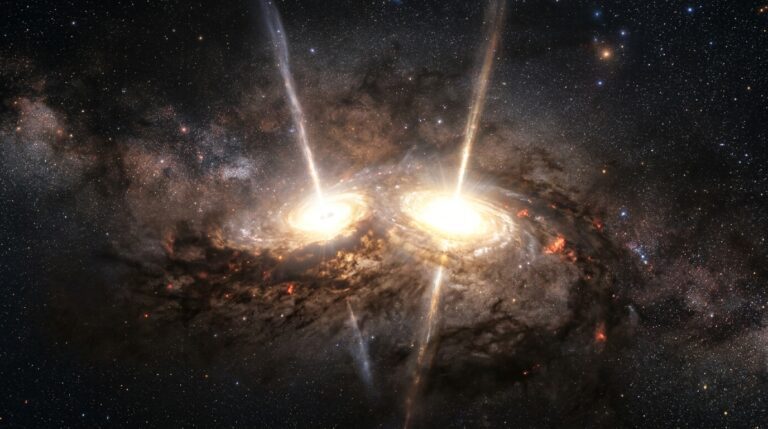
In roughly ten percent of these energetic core systems, magnetic fields twist into tight, powerful funnels near the event horizon. These intense magnetic choke points catch charged particles before they cross the point of no return and accelerate them outward at near-light speeds. These twin plasma columns drill out through the host galaxy’s ISM and extend across millions of light-years into intergalactic space. When these high-speed plasma streams are angled directly toward Earth, light-travel time effects create the optical illusion of superluminal motion, where features appear to travel faster than the speed of light. These particle jets produce intense synchrotron radiation, glowing brightly across radio wavelengths and cosmic particle detectors. Observing these massive particle cannons allows physicists to test extreme plasma dynamics and magnetohydrodynamics under conditions impossible to replicate in terrestrial laboratories.
Analyzing cosmological redshift distance measurements
Because light travels at a finite velocity, observing distant targets means looking directly backward into the early history of space and time. As the light from these energetic beacons travels across expanding space toward our detectors, its wavelength stretches toward longer, redder frequencies. Astronomers measure this redshift parameter to calculate exact cosmological distances and lookback times across billions of years. The most distant known examples were already shining brightly when our 13.8-billion-year-old cosmos was less than eight hundred million years old. Detecting these ultra-distant beacons poses a profound cosmic puzzle, as it forces theorists to explain how supermassive black holes grew to several billion solar masses so rapidly after the Big Bang. Consequently, these deep-sky lights serve as vital cosmic lighthouses, probing the epoch of reionization when the early universe first became transparent to ultraviolet light.

Investigating galactic collisions triggering quasar formation
A supermassive black hole cannot produce incredible luminosity without a vast, continuous supply of fresh matter to consume. In quiet, isolated galaxies, central black holes usually starve because surrounding stars maintain stable, circular orbits. However, when two massive galaxies undergo a gravitational collision, powerful tidal forces violently scramble galactic structure and drive massive gas clouds straight into the central core. This rapid gravitational funneling delivers hundreds of solar masses of matter directly to the central event horizon each year. High-resolution space telescope surveys reveal that many host galaxies display distorted spiral arms, tidal tails, and double nuclei, proving that galactic mergers trigger these cosmic infernos. Galaxy collisions were far more frequent in the early universe, explaining why peak activity occurred roughly ten billion years ago and has steadily declined since.
The Thermal Architecture of Accretion Disks
The physical structure of a supermassive accretion disk is a study in thermodynamic extremes. Near the outer rim, where material first joins the flow, temperatures remain relatively cool, emitting predominantly in the infrared and optical bands. As friction drives gas inward, kinetic energy transforms into heat, driving interior temperatures up to millions of degrees Celsius near the innermost stable circular orbit. At these extreme temperatures, matter fully ionizes into a churning, magnetized plasma that blasts out energetic X-rays and far-ultraviolet radiation. This intense light pressure exerts an outward force that balances the inward pull of gravity, setting an absolute physical threshold known as the Eddington limit. When accretion rates approach this critical boundary, radiation pressure literally blows away excess surrounding gas, creating a self-regulating thermodynamic engine that constantly throttles its own growth rate.
Cosmological Probes and Intergalactic Gas Absorption
Beyond their intrinsic physical fascination, these distant engines act as powerful natural probes for mapping the hidden structure of the cosmos. As their intense light travels billions of light-years across space, it passes through intergalactic hydrogen clouds and foreground galaxy halos. Each intervening gas cloud absorbs specific wavelengths, leaving a unique series of dark absorption lines known as the Lyman-alpha forest. By carefully dissecting these complex spectral absorption signatures, astronomers map the distribution, density, chemical enrichment, and temperature of intergalactic gas throughout cosmic history. Without these brilliant cosmic beacons illuminating distant hydrogen webs, the vast majority of normal baryonic matter in the universe would remain completely invisible to modern astronomical instruments.

Future Astronomy and Next-Generation Deep Space Surveys
Our understanding of cosmic powerhouses is expanding rapidly thanks to advanced ground-based observatories and space-based hardware. Next-generation facilities like the James Webb Space Telescope, the Vera C. Rubin Observatory, and the Extremely Large Telescope are probing the faint, dusty host galaxies that harbor early active cores. These advanced instruments combine infrared sensitivity with high-altitude adaptive optics, allowing scientists to strip away blinding glare and image surrounding stellar environments. Astronomers are also using gravitational wave detectors to record black hole mergers, pairing gravitational signals with electromagnetic data. Over the coming decade, these multi-messenger observation campaigns will unveil how primordial black hole seeds were born, how central engines interact with dark matter halos, and how the brightest objects in the universe shaped the modern cosmos.
How Artificial Photosynthesis Was Developed: Untold Story
The Latest Discoveries in Space That Are Changing Our View of the Universe
Why Does the Color of the Sky Change? The Science Behind Atmospheric Phenomena
Summary
Quasars: The Brightest Objects in the Universe represent the ultimate intersection of extreme gravity, fluid dynamics, and high-energy particle physics. Powered by supermassive black holes consuming vast amounts of gas during violent galactic collisions, these central engines generate light that outshines entire host galaxies across vast cosmological distances. From their dramatic discovery as point-like radio sources to their current role as cosmological probes, these cosmic lighthouses continue to reveal how galaxies grow, evolve, and shape the large-scale structure of space and time.
Frequently Asked Questions (FAQ)
1. What makes a quasar so exceptionally bright compared to a normal galaxy?
A quasar’s brightness comes from the immense gravitational friction and thermal energy generated as huge amounts of matter collapse into a central supermassive black hole. The infalling accretion disk converts gravitational energy into light far more efficiently than the nuclear fusion occurring inside standard stars, allowing a solar-system-sized region to outshine hundreds of billions of stars combined.
2. Is there a active quasar at the center of our Milky Way galaxy?
No, the supermassive black hole at the center of our Milky Way—Sagittarius A*—is currently dormant and inactive. While it possesses a mass of about 4 million Suns, it currently lacks the massive, continuous influx of infalling gas and dust necessary to light up as a quasar.
3. What is the key difference between a black hole and a quasar?
A black hole is a region of space where gravity is so strong that nothing, not even light, can escape from within its event horizon. A quasar is the glowing, ultra-bright region outside the event horizon, where infalling matter heats up and radiates immense light before crossing the point of no return.
4. How far away are the quasars we observe today?
The vast majority of quasars are located billions of light-years away from Earth. Because galaxy collisions and abundant free gas were far more common in the early universe, most active cores flourished roughly 7 to 11 billion years ago, meaning we only see them as they existed in the deep cosmic past.
5. Will our Milky Way ever become a quasar in the future?
Yes, it is very possible. In approximately 4.5 billion years, the Milky Way is scheduled to collide and merge with the neighboring Andromeda galaxy. This violent interaction will channel massive streams of interstellar gas toward our central black hole, potentially re-igniting it into a short-lived active quasar engine.
Call-To-Action (CTA)
Fascinated by the extreme physics powering the deep cosmos? Subscribe to our space exploration newsletter today to receive cutting-edge astronomical breakdowns, deep-sky telescope images, and real-time news on ground-breaking astrophysics discoveries delivered directly to your inbox!