
 Befrey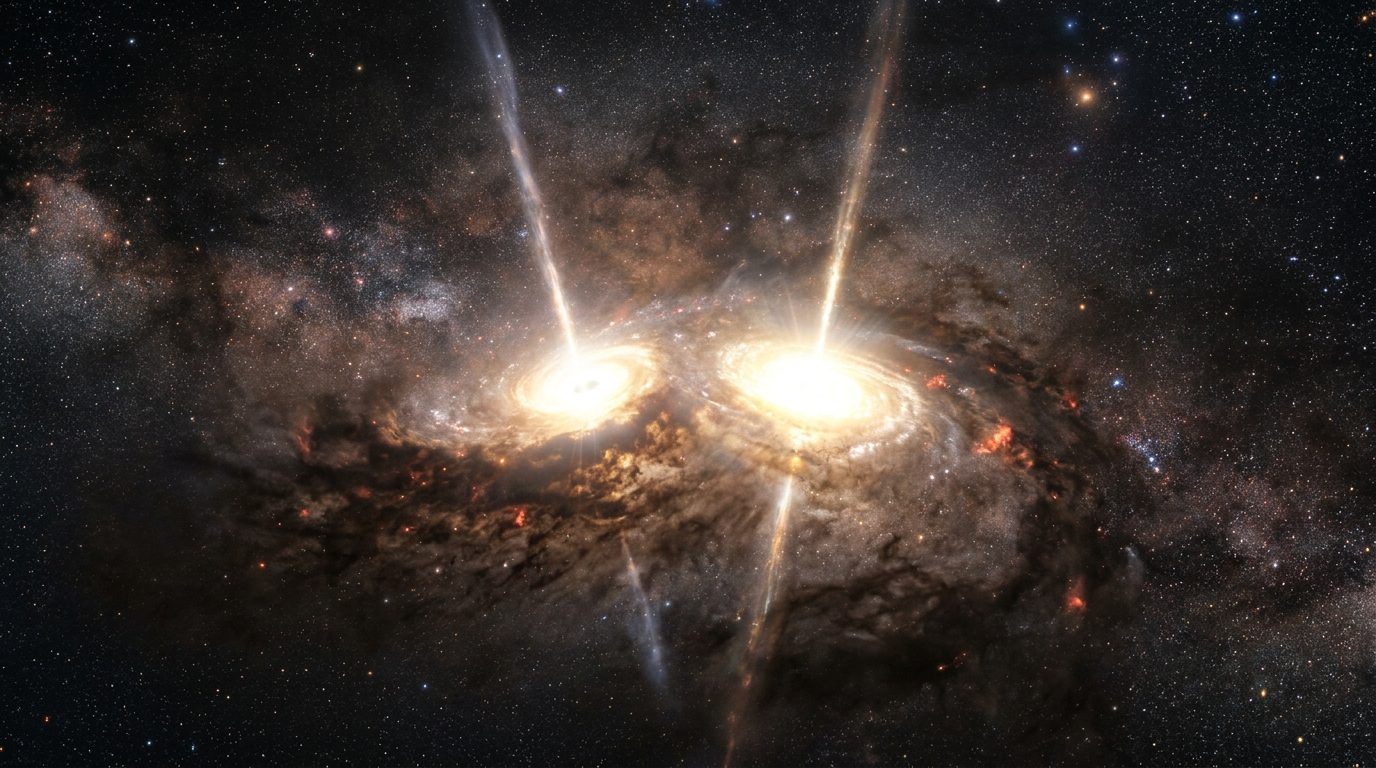
When you gaze up at the quiet night sky, the universe appears static, permanent, and peaceful. That serene view is a dramatic visual illusion masking an unending sequence of titanic cataclysms. Deep in space galaxy systems are constantly hurtling toward each other at millions of miles per hour. These immense celestial collisions do not instantly destroy everything in their path as standard sci-fi movies suggest. Instead, they act as the ultimate engine of creation across the cosmos. Celestial collisions refashion dead stellar neighborhoods, trigger furious waves of star birth, and reshape entire regions of the universe over billions of years.
The Secret Mechanics Behind Deep Space Galaxy Collisions
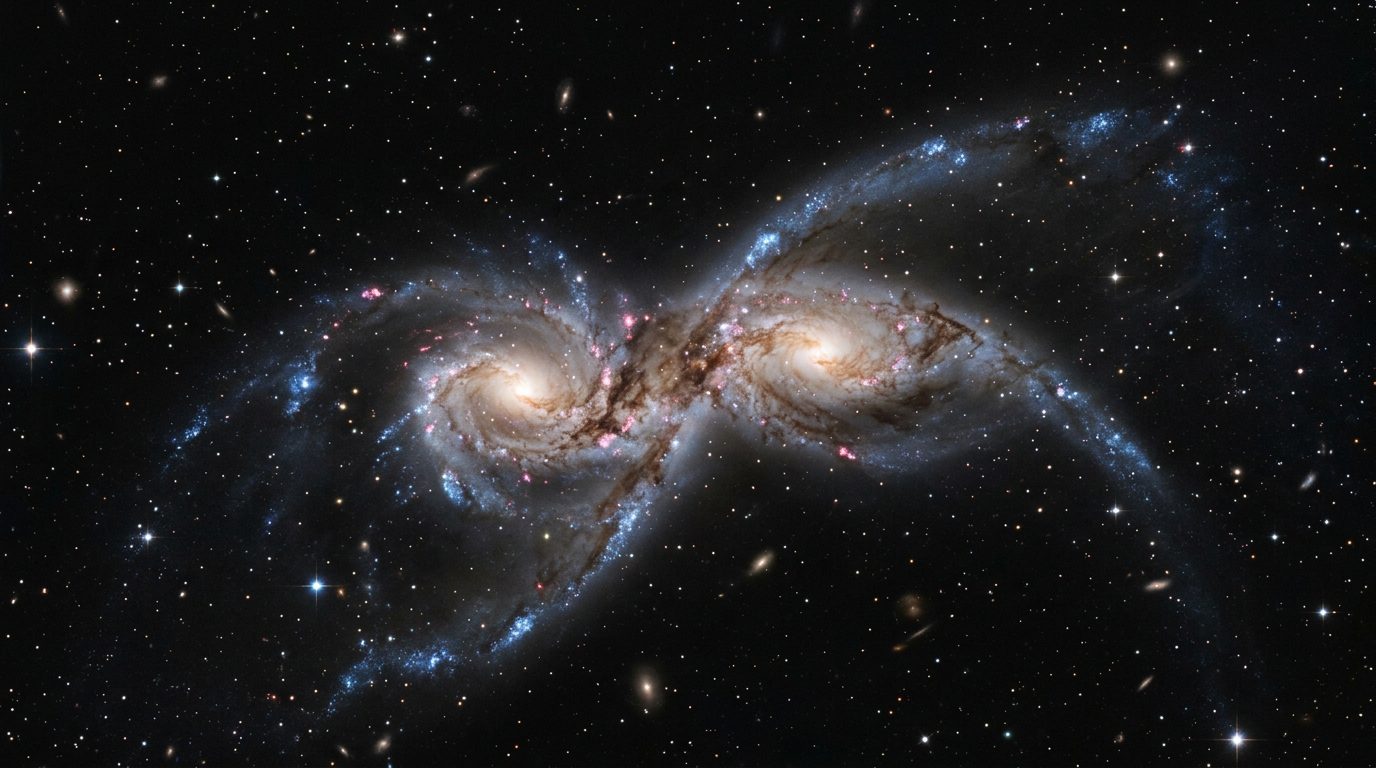
Celestial collisions are governed by the relentless pull of gravity acting over vast cosmic distances. As two giant structures draw close, their mutual gravitational fields pull on every star, gas cloud, and dark matter particle. This pull creates immense tidal forces that warp symmetric spiral arms into stretched structures called tidal tails. The actual physical space between individual stars is so vast that solar systems almost never smash directly into one another during a merger. Instead, the galaxies pass through each other like ghostly ships, locked in a long orbital dance. This gravitational interaction slowly bleeds away kinetic energy, ensuring that the two structures will eventually merge into one single entity.
How Tidal Forces Stretch Celestial Structures
Tidal forces act as galactic tug-of-wars, pulling harder on the near side of a neighboring galaxy than on its far side. This differential gravitational force distorts pristine spiral disks into dramatic, elongated streams of stars and dust. These long streams extend hundreds of thousands of light-years out into the vacuum of space. As the two systems orbit each other, these tidal tails pull vast quantities of material away from the galactic cores. This displaced material eventually settles into massive halo structures surrounding the newly forming merged system.
The Role of Dark Matter Halos in Accelerating Mergers
Visible stars and glowing gas clouds make up only a tiny fraction of a galaxy’s total mass. Surrounding every major galactic disk is an invisible, massive halo of dark matter. When two galaxies draw near, their invisible dark matter halos overlap first and experience friction known as dynamical friction. This interaction drags down the orbital velocity of both systems, converting their forward momentum into invisible heat within the halo. Without the gravitational drag provided by dark matter halos, colliding galaxies would simply bounce past each other and separate into space forever.
Hydrodynamic Shockwaves and Explosive Starbirth Events
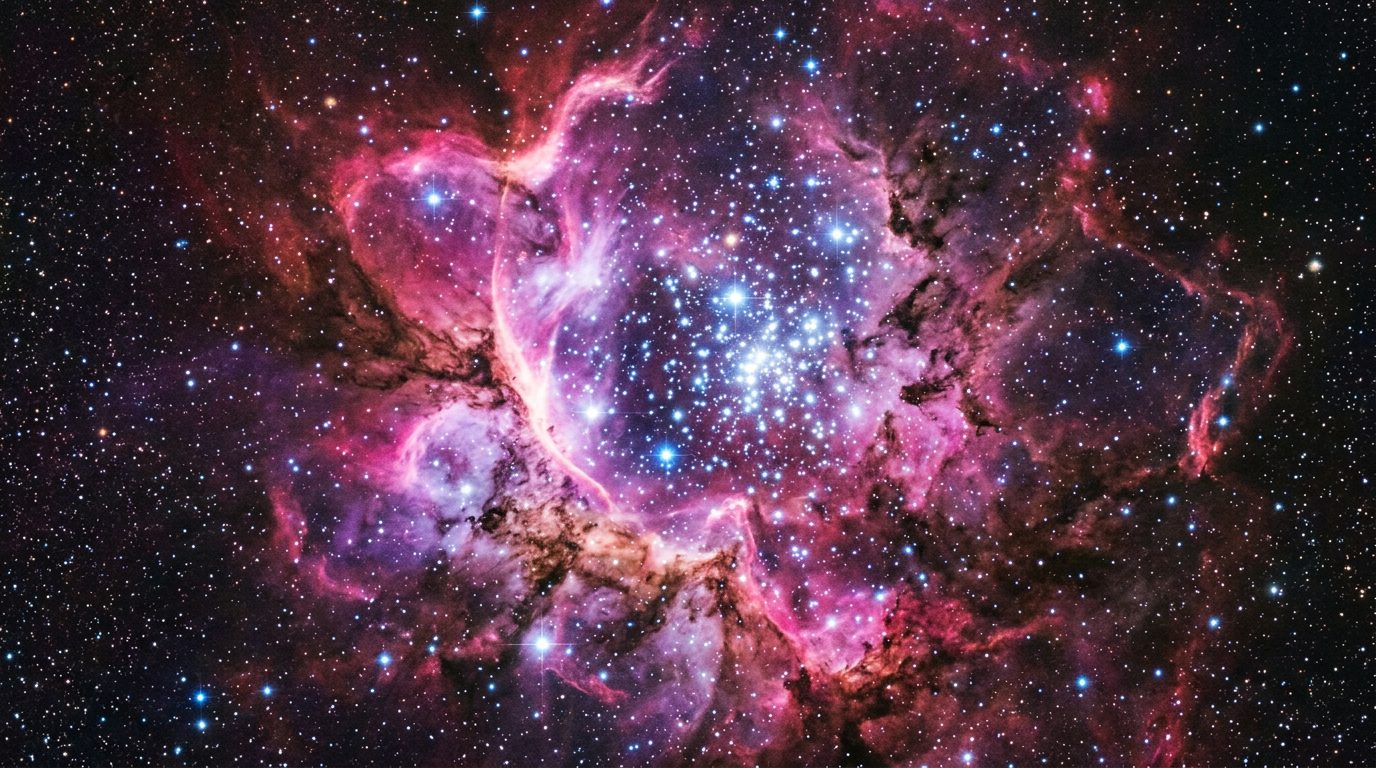
While stars pass by one another untouched during a collision, the interstellar gas clouds between them suffer a radically different fate. Galaxies contain vast reservoirs of cold hydrogen gas and cosmic dust. When two galactic gas disks overlap, these clouds collide directly at supersonic speeds, creating massive hydrodynamic shockwaves. The shockwaves compress diffuse hydrogen gas into incredibly dense, highly pressurized pockets. This sudden spike in pressure causes thousands of gaseous regions to collapse under their own gravity simultaneously. The ultimate outcome is an explosive event known as a starburst, where stars form at rates hundreds of times higher than normal.
Gas Compression along Interstellar Fronts
Supersonic collisions between interstellar gas clouds transform smooth gas distributions into complex, jagged filaments. As gas clouds smash together, shock fronts convert kinetic energy into thermal energy and localized compression zones. The compressed gas rapidly cools by radiating away infrared energy, allowing gravity to overcome thermal pressure. Once gravity takes over, thousands of stellar nurseries ignite almost at once along the shock fronts. These regions transform dark vacuum clouds into brilliant clusters of burning young suns.
Massive Star Cluster Creation in Extreme Environments
Starburst environments do not just create ordinary, isolated stars like our Sun. The extreme pressure conditions inside colliding gas disks force thousands of solar masses of hydrogen into incredibly tight volumes. This intense density fuels the creation of super star clusters—massive, tightly bound groupings containing millions of young stars. These giant clusters burn with incredible intensity, illuminating the surrounding gas clouds in bright ultraviolet light. However, these massive young stars consume their fuel quickly, setting the stage for thousands of simultaneous supernova explosions.
Supermassive Black Hole Mergers and Quasar Ignition
At the absolute center of almost every large galaxy resides a supermassive black hole containing millions or billions of solar masses. During a galactic collision, these central behemoths are drawn toward the newly formed center of mass through gravitational friction. As the two supermassive black holes spiral closer together, they disturb the surrounding galactic core. Large volumes of interstellar gas and dust are stripped of their angular momentum and funnel directly into the central abyss. This sudden frenzy of feeding turns dormant black holes into screaming super-bright quasars that light up the distant universe.
The Dual Black Hole Orbital Decay Process
When two supermassive black holes meet near the center of a merged galaxy, they form a bound binary pair. As they orbit one another, they continually scatter nearby stars into distant orbits, losing energy in the process. This stellar scattering slowly narrows the distance between the two black holes over hundreds of millions of years. Once the black holes get extremely close, they begin radiating energy outward as gravitational waves in the spacetime continuum. This final loss of energy causes the two black holes to merge into a single giant black hole.
Quasar Feedback and Galactic Gas Clearing
As vast amounts of gas fall toward the newly active central supermassive black hole, an accretion disk forms around it. Friction inside this fast-spinning disk heats gas to millions of degrees, producing immense amounts of radiation and powerful cosmic jets. This energy output is so violent that it drives a phenomenon known as galactic feedback. Powerful winds sweep outward from the galactic core, blowing remaining gas and dust completely out of the galaxy. By blasting away the remaining interstellar fuel, the central black hole effectively shuts off all future star formation.
Morphological Transformation: From Spirals to Giant Ellipticals
Galactic collisions serve as the primary architect of structure across the universe. They routinely transform highly organized, rotating spiral disks into featureless, random spherical shapes known as elliptical galaxies. Before a collision, a spiral galaxy maintains a flat, ordered disk structure where gas and stars rotate in predictable paths. The chaotic, chaotic gravitational forces unleashed during a merger destroy this clean orbital alignment completely. Stars are tossed into randomized, tilted orbits moving in every conceivable direction, permanently removing the signature spiral arms.
Distorting the Rotating Stellar Disk
The ordered motion of a spiral disk relies on a stable, uniform gravitational field. During a collision, the rapidly shifting gravitational landscape subjects rotating stars to unpredictable gravitational tugs. These continuous perturbations kick stars out of their clean circular paths, tilting their orbital planes at harsh angles. Over hundreds of millions of years, the flattened pancake shape of the spiral disk expands into a diffuse, three-dimensional stellar swarm.
The Thermalization of Stellar Orbits
As stellar orbits become randomized during a merger, astrophysicists describe the process as orbital thermalization. The organized kinetic energy of the rotating disk transforms into randomized kinetic energy spread out in three dimensions. Once this process reaches completion, the merged system displays no net direction of rotation. The galaxy settles into a smooth, featureless elliptical shape held together by the collective gravity of billions of stars moving in random directions.
The Galactic Lifecycle: Shutting Down Future Star Formation
The final phase of a major galactic collision marks a profound shift in a galaxy’s overall evolutionary lifecycle. Although the initial impact causes an unprecedented burst of new star birth, that intense activity cannot last forever. The combination of rapid fuel consumption during starburst events and powerful galactic winds driven by central quasars drains the galaxy of cold hydrogen gas. Without cold hydrogen gas, a galaxy loses its physical ability to form new stars. The newly formed elliptical galaxy transitions into a dormant state, earned the astronomical nickname of a “red and dead” system.
Starburst Fuel Consumption Limits
During a starburst phase, cold hydrogen gas converts into young stars at astonishing rates. A galaxy that previously produced two or three stars per year may suddenly produce hundreds of stars annually. At this rapid rate, the galaxy consumes its entire reservoir of cold molecular gas in a brief astronomical window of a few tens of millions of years. Once this gas reserves run out, the primary fuel source for future stellar generations vanishes forever.
The Transition to “Red and Dead” Status
Once star formation halts entirely, the stellar population of the newly merged elliptical galaxy begins to age. Short-lived, massive blue stars burn out quickly and explode as supernovae, leaving behind only long-lived, low-mass red stars. Without young blue stars to illuminate the system, the overall color of the galaxy shifts from brilliant blue to a dim, reddish hue. The galaxy enters a permanent twilight phase, drifting quietly through space without ever creating another generation of suns.
The Future Collision of the Milky Way and Andromeda
The physics of cosmic mergers is not just an abstract concept happening in far-off corners of deep space. It is the guaranteed future destiny of our own solar neighborhood. Our home galaxy, the Milky Way, is currently moving toward its largest neighbor, the Andromeda Galaxy, at roughly 250,000 miles per hour. Driven by mutual gravitational attraction, these two massive star systems are on a direct collision course. In approximately four to five billion years, our night sky will undergo a total transformation as the two galaxies meet, merge, and reform into a single massive elliptical galaxy nicknamed “Milkdromeda.”
The Multi-Billion Year Timeline to Impact
The journey toward the Milky Way-Andromeda merger is a long process unfolding over billions of years. For the next two billion years, Andromeda will appear as a growing band of light in our night sky. By three billion years from now, Andromeda’s spiral structure will dominate the night sky completely. Around four billion years into the future, the outer gas halos of both galaxies will collide, triggering a burst of star formation across the night sky. The full merger will finalize roughly six billion years from now, leaving behind a smooth elliptical system.
What Happens to Our Solar System and Earth
Despite the cosmic violence of the upcoming merger, our Sun and Earth will almost certainly survive the event physically intact. Because the distance between individual stars is so massive, the odds of another star colliding directly with our Sun are virtually zero. However, the shifting gravitational fields will likely drag our solar system out into a totally new orbit far away from the new galactic center. By the time this collision takes place, our Sun will have grown warmer and brighter, rendering Earth’s surface uninhabitable due to natural solar evolution long before the galactic collision completes.
Quasars: The Brightest Objects in the Universe — How?
The Latest Discoveries in Space That Are Changing Our View of the Universe
Exoplanets: Methods of Discovery and Potential for Life
Summary
-
Celestial collisions are driven by mutual gravity and dark matter friction, converting kinetic orbital energy into merged galactic structures.
-
Interstellar gas clouds smash together during mergers, triggering massive shockwaves and explosive starburst events that rapidly form millions of new stars.
-
Central supermassive black holes sink toward the center of the merged galaxy, consuming gas to ignite bright quasars that blast remaining gas into deep space.
-
The chaotic forces of a collision destroy ordered spiral disks, permanently transforming them into featureless, three-dimensional elliptical galaxies.
-
Mergers strip galaxies of cold hydrogen gas, halting future star creation and leaving behind dormant “red and dead” stellar systems.
-
The Milky Way and Andromeda galaxies will merge in four to five billion years, reshaping our night sky into a single elliptical galaxy known as Milkdromeda.
Frequently Asked Questions
Will two stars physically crash into each other when galaxies collide?
No, individual stars almost never collide during a galactic merger. The distance between stars inside a galaxy is vast compared to their actual physical sizes. For context, if our Sun were scaled down to the size of a ping-pong ball, the nearest neighboring star would be over 700 miles away. As a result, galaxies pass through each other like clouds of smoke without individual stars hitting one another.
How long does a full galactic collision take from start to finish?
A complete galactic merger is a slow astronomical process that takes anywhere from 500 million to several billion years to finish. The exact duration depends heavily on the initial sizes, speeds, angles of approach, and relative gas concentrations of the colliding galaxies.
Why do galaxies turn red after they merge with one another?
Galaxies turn red because they lose their ability to form new stars after a major collision. The initial collision uses up most of the cold gas fuel in a massive burst of star formation, while active black holes blow away the rest. Short-lived, hot blue stars die off quickly, leaving behind only cool, low-mass red stars that burn slowly for trillions of years.
What is dynamical friction and why is it important in space galaxy interactions?
Dynamical friction is a gravitational braking effect that occurs when a massive body moves through a surrounding cloud of dark matter or stars. As a galaxy moves through these background particles, its gravity pulls material behind it, creating a dense gravitational wake. This wake pulls backward on the moving galaxy, slowing it down and forcing it to spiral inward toward a merger.
Is our Sun going to be thrown out of the galaxy when Andromeda hits?
There is a reasonable chance that our solar system will be relocated to a different part of the galaxy. Simulations show a roughly 50% chance that our Sun will be pulled into a distant galactic tail during the initial pass, and a smaller chance it will be ejected into the outer halo entirely. However, the solar system itself will remain intact during this gravitational relocation.
Unlocking The Secrets Of Deep Space Galaxy Evolution
The universe is constantly moving, reshaping ancient structures and creating brand-new stellar nurseries across deep space. Understanding how giant galaxies collide gives us a preview of our own distant cosmic future. Explore our full library of deep-space guides, interactive star maps, and observational astrophysics articles to stay ahead of every major astronomical discovery!





