Befrey
A Watch with a Miniature V16 Engine? How Is That Possible?
A watch with a miniature V16 engine sounds impossible. Yet Jacob & Co. built exactly that. The New York-based watchmaker fitted a working, moving replica of a Bugatti hypercar engine onto a human wrist. Sixteen tiny cylinders sit in a row. A microscopic crankshaft spins. Pistons pump up and down in real time, just like the real thing. This is not a printed dial or a painted illustration of an engine. It is a genuine mechanical automaton, carved from sapphire crystal and hand-finished steel, built to recreate a supercar’s heartbeat on a wrist. So how exactly did Jacob & Co. fit a working Bugatti engine into a wristwatch? The story begins with an unlikely partnership between two very different worlds of extreme engineering.
The Jacob & Co Bugatti Tourbillon Watch: A Partnership Built on Extremes
Every great collaboration needs two brands that already push their own industries to the edge. Jacob & Co. has spent decades building watches known for scale, spectacle, and mechanical theater. Bugatti has spent over a century building cars that exist purely to break records. The two companies formally joined forces in 2019, and the partnership rolled out across a multi-year collaboration between the luxury brands. The first release was a triple-axis tourbillon called the Twin Turbo Furious, which borrowed Bugatti’s design language without yet housing a full engine replica. That changed in 2020, when Jacob & Co. unveiled the Bugatti Chiron Tourbillon, the first watch to house a functioning miniature version of the Chiron hypercar’s legendary engine. Four years later, the partnership reached a new peak. When Bugatti unveiled its all-new Tourbillon hypercar in 2024, Jacob & Co. simultaneously revealed a companion watch rebuilt from the ground up to mirror that car’s completely redesigned engine. Each release pushed the miniaturization further, turning the wrist into a genuine stage for automotive engineering rather than just automotive styling. Exquisite Timepieces
Building a Miniature Engine Inside a Wristwatch
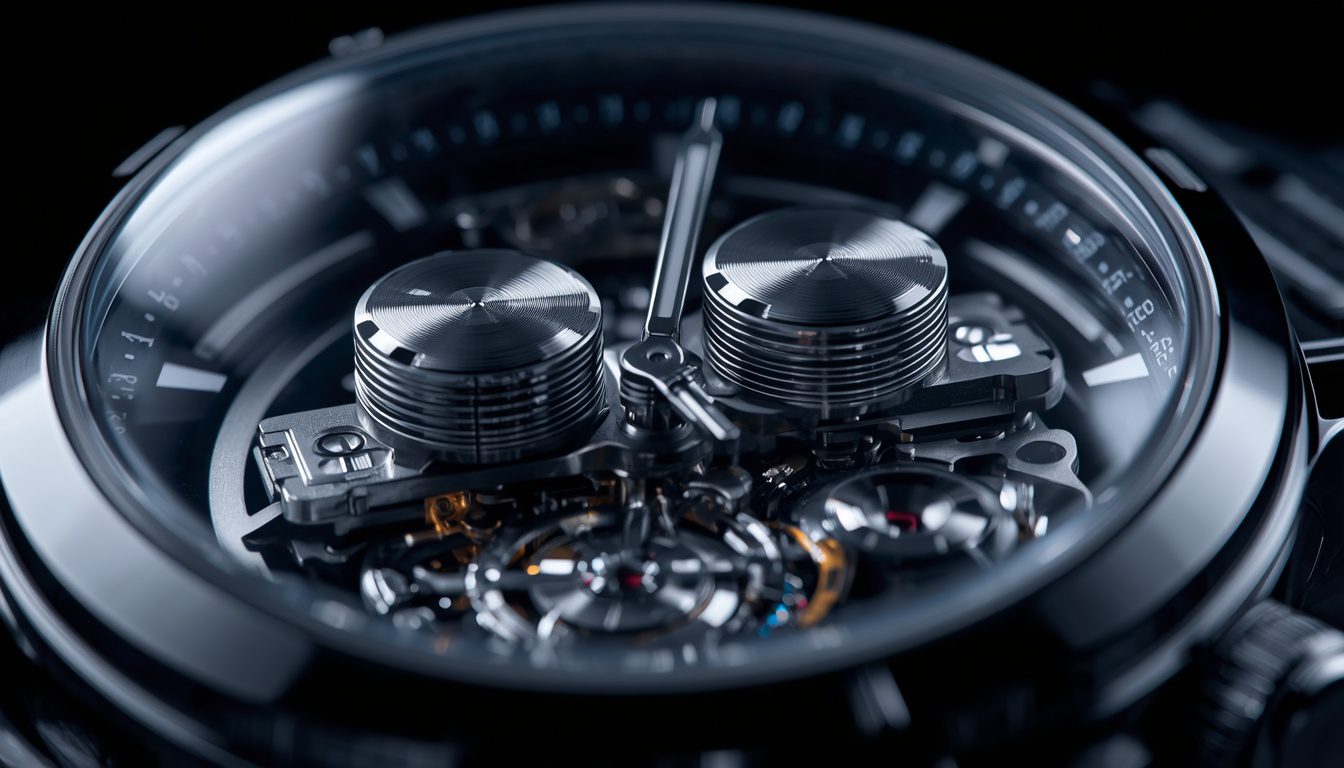
Shrinking a multi-cylinder engine down to fit inside a case barely bigger than a matchbox is not a styling exercise. It is a genuine engineering problem, and Jacob & Co. approached it the way a race team approaches a chassis, not the way a jeweler approaches a bracelet. The entire engine block sits inside a solid piece of synthetic sapphire crystal, chosen because it is transparent, scratch-resistant, and strong enough to survive constant mechanical stress from moving parts inside it. This sapphire block houses moving pistons and rotating components that are activated by pressing a side actuator, and carving that block without a single flaw takes real patience. Producing one flawless sapphire block reportedly takes months, since any defect discovered during production forces the entire crystal to be discarded. Every piston, every cylinder wall, and every tiny connecting rod has to be machined at a scale normally reserved for watch gear trains, not engine blocks. Nothing about this process can be rushed, because a single micron of error can jam a mechanism smaller than a fingernail. The result looks less like a watch component and more like a jewel that happens to breathe and move. Robb ReportRobb Report

Inside the Working Piston Mechanism: How the Sixteen Cylinders Move
The heart of the design is not the dial. It is the engine block automaton sitting where a dial would normally be. The block is fashioned from a single piece of sapphire, drilled to house sixteen cylinders that each hold a titanium piston, all driven by a single-axis crankshaft. Press the activation pusher built into the crown, and the entire assembly comes alive. The crankshaft begins to turn, the sixteen pistons pump up and down in sequence, and tiny exhaust manifolds complete the illusion of a running engine. This working piston mechanism watch does not tell time through this animation; the sequence exists purely as mechanical theater, lasting roughly twenty seconds before it needs to be rewound. A single winding of the crown can power roughly twenty separate activations of the animation before the automaton barrel runs dry. Earlier versions of this idea went even further by adding spinning turbochargers alongside the pistons, mimicking the forced-induction system of the real hypercar engine. Watching sixteen pistons fire in perfect sync, on a component smaller than a coin, is genuinely difficult to process the first time you see it move. Luxury Bazaar + 2
The Hand-Wound Tourbillon Movement That Keeps Real Time
Underneath all that spectacle sits a fully functional, hand-wound tourbillon movement doing the actual job of keeping time. The current generation caliber, known as JCAM55, is a manufacture movement built specifically for this collection rather than adapted from an existing design. It comprises 557 individual components, uses 74 jewels, runs at 21,600 vibrations per hour, and delivers roughly 48 hours of power reserve once fully wound. The dial layout splits the display into three distinct zones so the engine automaton can dominate the center without sacrificing legibility. A thirty-second flying tourbillon sits to one side, jumping retrograde hours and minutes with a Bugatti shield logo occupy the center, and a double power reserve indicator tracking both the timing mechanism and the automaton sits opposite the tourbillon. A separate hand-wound tourbillon movement, called JCAM37, powered the original 2020 Chiron Tourbillon watch, and it was no less ambitious. That earlier caliber packed 578 components and 51 jewels into a movement measuring just 41.7 by 36 millimeters. Both calibers prove the same point: building a convincing engine animation is only half the challenge, because the watch still has to function as a serious, chronometrically capable timepiece. Luxury Bazaar + 2
Designing a Bugatti-Inspired Luxury Timepiece, Inside and Out
None of this mechanical drama would land without a case designed to match it visually. The current Bugatti Tourbillon watch wears a case finished in black PVD titanium, chosen because it echoes the matte, race-derived finishes found on the actual hypercar. The case measures 52 millimeters long, 44 millimeters wide, and just 15 millimeters thick, and it uses seven separate sapphire crystals with anti-reflective coating to expose the mechanism from nearly every angle. The twelve o’clock side of the case borrows the car’s signature horseshoe grille shape, complete with a Bugatti logo pressed directly into the caseband. Earlier Chiron Tourbillon models leaned into flowing, tonneau-shaped cases that mirrored the swooping bodywork of the actual Chiron, and some editions replaced metal entirely with cases carved from solid colored sapphire crystal. This Bugatti-inspired luxury timepiece treats the case itself as part of the automaton, not simply as a container for it. Every curve, vent, and grille line exists because a real designer traced it directly from automotive reference sketches, not from a generic watch mood board. Luxury Bazaar

V16 or W16? Untangling the Engine Confusion in Jacob & Co.’s Watches
Here is where things get genuinely interesting for anyone who actually knows engines. The original 2020 Chiron Tourbillon replicated the real Chiron hypercar’s engine, and that engine is technically a W16, not a V16. The Chiron’s engine is an 8.0-liter quad-turbocharged W16 producing roughly 1,479 horsepower, arranged as two narrow-angle VR8 blocks joined together in a W formation rather than a simple single-angle V. That is why the original watch’s automaton, and most retailers describing it, correctly call it a W16 engine block. Everything changed in 2024, when Bugatti replaced the Chiron with an entirely new hypercar simply called the Tourbillon. That new car uses an 8,355cc naturally aspirated Cosworth-built V16, paired with three electric motors for a combined output of roughly 1,800 metric horsepower, and critically, it drops the turbochargers entirely in favor of natural aspiration and hybrid assistance. Because that new engine is a genuine single-bank V16 rather than a W-shaped unit, Jacob & Co.’s companion watch automaton is correctly, and finally, described as a true miniature V16 engine. So a watch with a miniature V16 engine is real, but it specifically refers to the newer Bugatti Tourbillon watch, while its 2020 predecessor is technically a miniature W16. aBlogtoWatchJacob & Co.
Price, Rarity, and Who Actually Gets to Own One
None of this comes cheap, and Jacob & Co. never intended it to. The original titanium-cased Chiron Tourbillon launched at roughly $280,000, with production reportedly capped around 250 individual pieces to preserve exclusivity. Precious metal editions pushed the price considerably higher, with a blue titanium version priced around $300,000 and a rose gold version reaching approximately $380,000. Fully gem-set editions climbed even further into rarified territory, with one heavily diamond-set variant carrying a price tag of roughly $560,000. The newer Bugatti Tourbillon watch, tied directly to a hypercar that itself starts around $4.1 million, sits in an even more exclusive bracket reserved largely for existing Bugatti clients and serious watch collectors. Very few of these pieces will ever change hands publicly, since most buyers hold onto them as centerpiece collection pieces rather than trading assets. Owning one of these watches essentially means owning a piece of automotive history that happens to also tell time. DriveMagMonochrome Watches
Why This Watch Matters for the Future of High-End Watchmaking
Automaton watches are not new; miniature scenes and moving figures have existed in horology for centuries. What makes this collaboration different is the direction the inspiration travels. Instead of a watch simply borrowing a car’s colors or logo, Jacob & Co. reverse-engineered an actual piece of automotive machinery and rebuilt it at watch scale. Bugatti returned the favor on the car side too, since the new Tourbillon hypercar’s own dashboard cluster uses over 600 titanium components under a skeletonized, sapphire-covered design that deliberately borrows from fine watchmaking. That kind of two-way exchange between horology and automotive engineering used to be rare, limited mostly to brands like Jaeger-LeCoultre or Audemars Piguet building the occasional dashboard clock for a luxury car maker. Now it looks increasingly like a genuine design movement, where engine engineers and watch engineers sit at the same table from day one. Expect more hypercar brands to chase this kind of crossover, because once a customer sees a working piston mechanism watch move, a painted dial simply cannot compete. This watch with a miniature V16 engine may end up remembered less as a novelty and more as the moment two industries stopped just borrowing logos from each other and started actually building things together.
Kevlar body armor: It looks like something out of a Bond movie, but it can stop a bullet from a handgun.
The World’s Most Expensive Pocket Knife: Why a Pocket Knife Set with Diamonds Costs More Than a New Villa.
Watches Made from Moon Dust and Meteorites: What It’s Like to Wear a Piece of the Universe on Your Wrist for Half a Million
Summary
Jacob & Co. and Bugatti spent years building toward a watch that does something almost no other timepiece attempts: recreate a working hypercar engine at wrist scale. The 2020 Chiron Tourbillon introduced a miniature W16 automaton with moving pistons, a solid steel crankshaft, and tiny turbochargers, all housed in sapphire crystal and powered by the hand-wound JCAM37 caliber. The 2024 Bugatti Tourbillon watch went further, matching the real car’s switch to a naturally aspirated V16 engine with a redesigned JCAM55 movement, a triple-subdial layout, and an even more intricate engine block automaton. Both watches sit in extremely limited production, carry six-figure-and-up prices, and represent one of the clearest examples of genuine automotive engineering translated directly into fine watchmaking rather than just automotive-themed styling.
FAQ
Is the engine inside the watch actually functional as an engine?
No. It moves exactly like a real engine, with pistons pumping and a crankshaft spinning, but it produces no power and performs no timekeeping function. It exists purely as a mechanical automaton for visual spectacle.
How long does the engine animation run once activated?
The animation typically runs for about twenty seconds per activation, and a full winding of the automaton barrel can usually power the sequence roughly twenty times before it needs rewinding.
What is the actual difference between the W16 and V16 versions of this watch?
The 2020 Chiron Tourbillon replicates the original Chiron’s turbocharged W16 engine, built from two narrow VR8 blocks joined in a W shape. The 2024 Bugatti Tourbillon watch replicates the newer hypercar’s naturally aspirated V16, a genuine single-bank sixteen-cylinder layout.
How many of these watches were actually made?
Production is extremely limited across every edition, with early titanium models reportedly capped around 250 pieces and precious metal or fully gem-set versions produced in even smaller numbers.
Do you need to own the actual Bugatti car to buy the watch?
No. While many buyers are existing Bugatti hypercar owners, the watches have historically been sold independently through Jacob & Co. and authorized retailers to serious collectors regardless of garage contents.
Call to Action
If a watch with a miniature V16 engine sounds like the kind of mechanical obsession you want to follow closely, stick around. This is exactly the level of engineering storytelling we dig into every week, so subscribe, follow, and drop a comment with the automaton watch you’d want us to break down next.