
 Befrey
Why do some viruses become extremely resistant to everything we throw at them? It’s one of the most unsettling questions in modern medicine. Some infections clear up in a week with basic treatment. Others turn into stubborn, hard-to-kill invaders that shrug off antivirals and slide past our immune defenses like they were never there. Scientists call this stubborn survival trait viral resistance, and it explains why certain viral strains keep coming back no matter what we do. To understand why some viruses become so tough, we need to look inside their biology, their evolution, and the constant battle they wage against our bodies and our medicines.
The Hidden Power of Viral Mutation Rate
Every time a virus copies itself, it makes mistakes. These mistakes are called mutations, and they happen far more often in viruses than in most living organisms. A high viral mutation rate means the virus produces slightly different versions of itself with every single replication cycle. Most of these changes are harmless or even harmful to the virus itself. But every so often, a mutation accidentally helps the virus survive a drug, dodge an antibody, or replicate faster than before. Because viruses reproduce in huge numbers within a single infected person, even a rare beneficial mutation gets tested millions of times over. This sheer volume of trial and error is what gives viruses their frightening adaptability. RNA viruses like influenza, HIV, and coronaviruses mutate especially fast because their copying machinery lacks strong proofreading ability, unlike the more careful DNA-copying systems found in human cells. Over time, this rapid mutation rate becomes the raw material that resistance is built from.
How Antiviral Drug Resistance Mechanisms Develop Over Time
Antiviral drugs work by targeting a specific part of the virus, such as an enzyme it needs to copy its genetic material. Antiviral drug resistance mechanisms develop when a mutation changes the shape of that exact target, so the drug can no longer bind properly. Once this happens, the drug becomes far less effective, sometimes almost useless, against that particular strain. This process speeds up dramatically when people stop treatment early or take incomplete doses, because a weakened dose kills off the weak virus copies while letting tougher, partially resistant ones survive. Those survivors then multiply freely, since their main competition has been wiped out. In some cases, resistance appears through more than one small change, stacking mutations that each add a bit more protection against the drug. Doctors sometimes fight this by combining several antivirals at once, a strategy borrowed directly from HIV treatment, because it is far harder for a virus to develop resistance to multiple drugs simultaneously. Still, given enough time and enough replication cycles, some viruses eventually find a way around even combination therapy.
Immune System Evasion Strategies That Keep Viruses Alive
Even without any medication involved, viruses face constant pressure from the human immune system, and this is where immune system evasion strategies come into play. Some viruses regularly change the proteins on their outer surface, a trick known as antigenic drift, so antibodies from a past infection no longer recognize them. Influenza is the textbook example, which is exactly why a new flu vaccine is needed nearly every year. Other viruses go even further with antigenic shift, a sudden and dramatic reshuffling of surface proteins that can create entirely new strains almost overnight. Some viruses coat themselves in a thick layer of sugar molecules called glycans, essentially hiding their vulnerable surfaces behind a molecular shield that antibodies struggle to penetrate. Certain viruses can also block interferons, the chemical alarm signals our cells release to warn neighboring cells of an infection. A few viruses, like herpes and HIV, take an even sneakier approach by going dormant inside cells for years, becoming almost invisible to immune surveillance until conditions favor reactivation. Together, these evasion tricks let viruses persist in a population long after a simpler pathogen would have been wiped out.
Virus Evolution and Natural Selection in Action
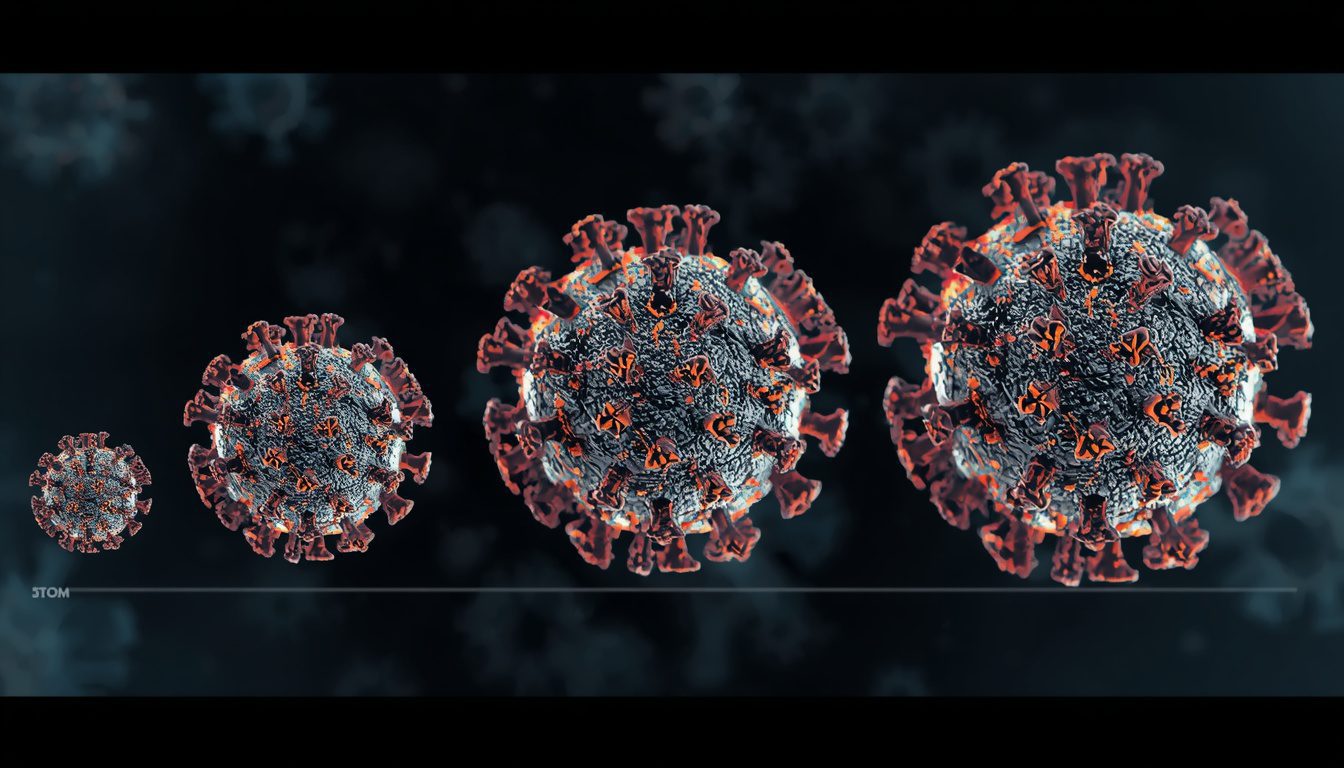
At its core, virus evolution and natural selection follow the same basic rules as evolution in any living creature, just compressed into an incredibly short timescale. Every infected person essentially becomes a miniature evolutionary laboratory, with billions of virus particles competing to replicate the fastest and spread the furthest. Viral variants that happen to resist a drug, dodge an antibody, or transmit more efficiently automatically get more chances to reproduce. Weaker or more vulnerable variants simply get outcompeted and fade from the population over time. This process accelerates enormously during outbreaks, since more infected people mean more replication events and therefore more chances for a useful mutation to appear. Transmission between hosts also creates what scientists call a genetic bottleneck, where only a small number of virus particles make it into the next person, sometimes randomly favoring an already-resistant variant. Because natural selection has no goal or intention, resistance isn’t something a virus “decides” to develop; it simply emerges because resistant variants survive better under pressure. This blind but relentless process is precisely why resistant strains so often appear exactly when and where we least expect them.
Inside the World of RNA Virus Quasispecies
One of the most fascinating concepts in virology is RNA virus quasispecies, a term describing how a single viral infection isn’t really one virus but a whole cloud of closely related variants. Because RNA viruses replicate so sloppily, an infected person doesn’t host one identical virus but millions of slightly different versions all mixed together. This mutant swarm acts almost like an insurance policy for the virus, since even if the dominant variant gets wiped out by a drug or antibody, a rare variant hiding within the swarm might already carry the resistance needed to survive. When treatment or immune pressure removes the majority strain, one of these minor variants can quickly take over and become the new dominant version. This quasispecies structure is a major reason why viruses like hepatitis C and HIV are so difficult to fully eliminate from the body. It also explains why a single antiviral drug often fails where multiple drugs, aimed at different weaknesses, succeed. Researchers now study quasispecies diversity as an early warning signal, since a virus with a wide and varied mutant swarm is statistically more likely to develop resistance quickly.
The Rise of Drug-Resistant Virus Strains Worldwide
Public health agencies track drug-resistant virus strains closely because their spread has real consequences far beyond a single patient. Oseltamivir-resistant strains of influenza have appeared in past flu seasons, forcing doctors to switch treatment strategies mid-outbreak. Acyclovir-resistant herpes strains show up more frequently in people with weakened immune systems, where the drug has more opportunities to apply prolonged selective pressure. HIV treatment history is essentially the story of resistance, which is exactly why modern therapy always combines multiple drug classes rather than relying on a single medication. Hospitals and health organizations now use genetic sequencing to monitor circulating strains in real time, watching for known resistance mutations before they become widespread. This global surveillance effort matters enormously, because a resistant strain that emerges in one region can spread internationally within weeks thanks to modern travel. Left unmonitored, drug-resistant virus strains can quietly undermine years of medical progress, turning once-manageable infections back into serious public health threats.
Why Some Viruses Resist Treatment Better Than Others
Not every virus is equally capable of becoming resistant, and the differences come down to some fairly basic biology. DNA viruses generally mutate more slowly than RNA viruses because DNA-copying enzymes include built-in proofreading and error-correction steps. Smaller, simpler viruses can also mutate faster relative to their genome size, since even a single change affects a larger proportion of their genetic code. Viruses with extremely short replication cycles produce far more generations in a given time period, giving natural selection more opportunities to act. Population size plays a huge role too, since viruses that infect enormously large numbers of people or cells simply generate more genetic variety overall. Some viruses also have structurally rigid proteins that can’t easily change shape without breaking their own function, which naturally limits how much resistance they can develop. Environmental and biological pressures matter as well, since a virus facing constant drug exposure or strong immune pressure evolves resistance far faster than one that rarely encounters either.

What Scientists Are Doing to Fight Back
Researchers aren’t standing still while viruses evolve, and several promising strategies are already changing how resistance gets managed. Combination therapy remains one of the most effective tools, since forcing a virus to develop resistance to several drugs at once is exponentially harder than resisting just one. Scientists are also developing broad-spectrum antivirals designed to target parts of a virus that rarely mutate, making resistance far less likely to emerge. Universal vaccine research, particularly for influenza, aims to target stable viral regions instead of the fast-changing surface proteins that drift year after year. Genomic surveillance networks now sequence thousands of viral samples worldwide, spotting resistance mutations early enough to adjust treatment guidelines before a strain spreads widely. Artificial intelligence and machine learning tools are increasingly used to predict which mutations are likely to arise next, giving researchers a head start on designing future drugs. Public health messaging around completing full courses of antiviral treatment, rather than stopping early, also plays a quieter but genuinely important role in slowing resistance at the population level.
The Future of Virus Resistance: What to Expect
Looking ahead, virus resistance is likely to remain a permanent feature of infectious disease rather than a problem we simply solve once and move on from. As global travel and population density continue rising, viruses will keep encountering more hosts, more drug exposure, and more opportunities to evolve. At the same time, faster genetic sequencing technology means scientists can detect emerging resistant strains in days rather than months, dramatically shortening our reaction time. Personalized medicine approaches may eventually allow doctors to choose antiviral combinations based on a patient’s specific viral genetic profile, reducing the trial-and-error that fuels resistance. Continued investment in vaccine research, especially targeting stable viral structures, offers one of the most promising long-term defenses available. Individual choices still matter enormously in this bigger picture, since completing prescribed treatments and staying current on vaccinations directly reduces the opportunities viruses have to adapt. The overall outlook isn’t hopeless, but it does demand constant vigilance, since resistant viruses evolve on their own timeline, indifferent to how prepared or unprepared we happen to be.
The Latest Discoveries in Space That Are Changing Our View of the Universe
Deep-Sea Research: What Secrets Do the Oceans Hide?
How Particle Teleportation Works in Scientific Experiments
Summary
Viruses become extremely resistant through a combination of rapid mutation, natural selection, immune evasion, and the pressure created by antiviral treatments themselves. RNA viruses mutate especially quickly due to sloppy copying machinery, generating diverse mutant swarms known as quasispecies that make full elimination difficult. Drug resistance typically emerges when mutations change the exact target a medication was designed to attack, a process accelerated by incomplete treatment courses. Immune evasion strategies like antigenic drift, glycan shielding, and viral dormancy allow certain viruses to persist for years despite constant immune pressure. Scientists combat this ongoing arms race with combination therapies, genomic surveillance, and next-generation vaccine research aimed at more stable viral targets.
FAQ
1. What does it actually mean when a virus is called “resistant”?
It means the virus has developed genetic changes that let it survive a drug, vaccine-induced antibody, or immune response that would normally stop it.
2. Why do RNA viruses mutate faster than DNA viruses?
RNA-copying enzymes generally lack the strong proofreading ability found in DNA-copying enzymes, so errors slip through and accumulate much more quickly.
3. Can vaccines still work against resistant virus strains?
Often yes, though effectiveness can drop if a strain changes its surface proteins significantly, which is why some vaccines, like the flu shot, need regular updates.
4. How do doctors detect drug-resistant viruses?
Through genetic sequencing of samples from patients, comparing the virus’s genome against known resistance mutations to guide treatment decisions.
5. Can virus resistance be prevented or reversed?
It can be slowed through combination therapies, completing full treatment courses, and strong vaccination coverage, though fully reversing existing resistance in a population is extremely difficult.
CTA
If this pulled back the curtain on how viruses outsmart medicine, don’t keep it to yourself. Share it with someone who needs to understand why “just take the pills” isn’t the whole story, and follow along for more deep dives into the hidden science shaping our health.






