The Best Workout for Beginners Fixed My Energy Fast and Unlocked the Secret to Real Strength
 Befrey
Starting a new fitness journey can feel completely overwhelming when you are bombarded with endless contradictory advice online. Finding the best workout for beginners requires cutting through the noise and focusing on proven, science-based movement patterns that yield sustainable results. If you have been searching for a reliable starter fitness routine, a structured novice exercise program, or an approachable first-time workout plan, you are in the exact right place. The primary goal for any beginner is not to push to absolute exhaustion on day one, but to establish consistent habits, master basic motor patterns, and build foundational physical strength. By focusing on total-body movements and manageable training frequency, the best workout for beginners transforms your physical health without causing debilitating soreness or burnout.
Why Most Novice Exercise Programs Fail
The fitness industry often sells extreme transformation challenges that promise miraculous overnight results. These aggressive programs usually overload inexperienced joints and nervous systems with excessive volume, leading directly to injury or mental frustration. When a beginner attempts an advanced bodybuilder split or a brutal high-intensity interval session, the resulting muscle damage can stall progress for weeks. True physical adaptation requires a balanced approach where stimulus is paired with adequate recovery and progressive movement complexity. Beginners thrive when they master fundamental movement patterns like pushing, pulling, squatting, and hinging rather than relying on complex, fancy exercises. Understanding how your body responds to low-to-moderate resistance allows you to safely push past initial plateaus. Sustainable success comes from building momentum through small, consistent wins rather than temporary, extreme efforts.
full body gym routine for beginners
Executing a full body gym routine for beginners is the most efficient way to stimulate muscle growth and build systemic strength. Training every major muscle group three times per week maximizes muscle protein synthesis while keeping session durations short and focused. A typical workout starts with a multi-joint lower body exercise such as a dumbbell goblet squat or leg press to engage the quads, glutes, and core. Next, you move into a horizontal upper body push, such as a dumbbell bench press or machine chest press, which develops the chest, anterior shoulders, and triceps. To balance the torso, you immediately follow with a horizontal pull, such as a chest-supported row or seated cable row, targeting the upper back and lats. You then round out the session with a vertical overhead press for shoulder stability and a vertical pull like a lat pulldown. Performing two to three sets of 8 to 12 controlled repetitions per movement provides the optimal stimulus for a novice without overwhelming recovery capacity. Rest for 90 to 120 seconds between sets to ensure your neuromuscular system is fully restored before your next effort.

easy home workout plan without equipment
You do not need an expensive gym membership or specialized machinery to build functional strength and burn calories effectively. An easy home workout plan without equipment relies entirely on bodyweight leverage, gravity, and body awareness. You can begin your session with chair squats or wall-supported sit-to-stands, which teach proper hip-hinging and knee tracking while strengthening your legs. Incline push-ups against a kitchen counter or sturdy table allow you to adjust the difficulty level easily while working your upper body pushing muscles. For posterior chain development, bodyweight glute bridges performed on the floor target the hamstrings and glutes without stressing the lower spine. Doorframe rows or towel isometric pulls help engage the upper back muscles that offset poor desk posture. Core stability can be trained dynamically through bird-dog holds and dead bugs, which protect the lumbar spine while building midsection control. Completing these exercises in a smooth circuit format for 20 to 30 minutes keeps your heart rate elevated while reinforcing excellent movement technique.
progressive overload principles for beginner fitness
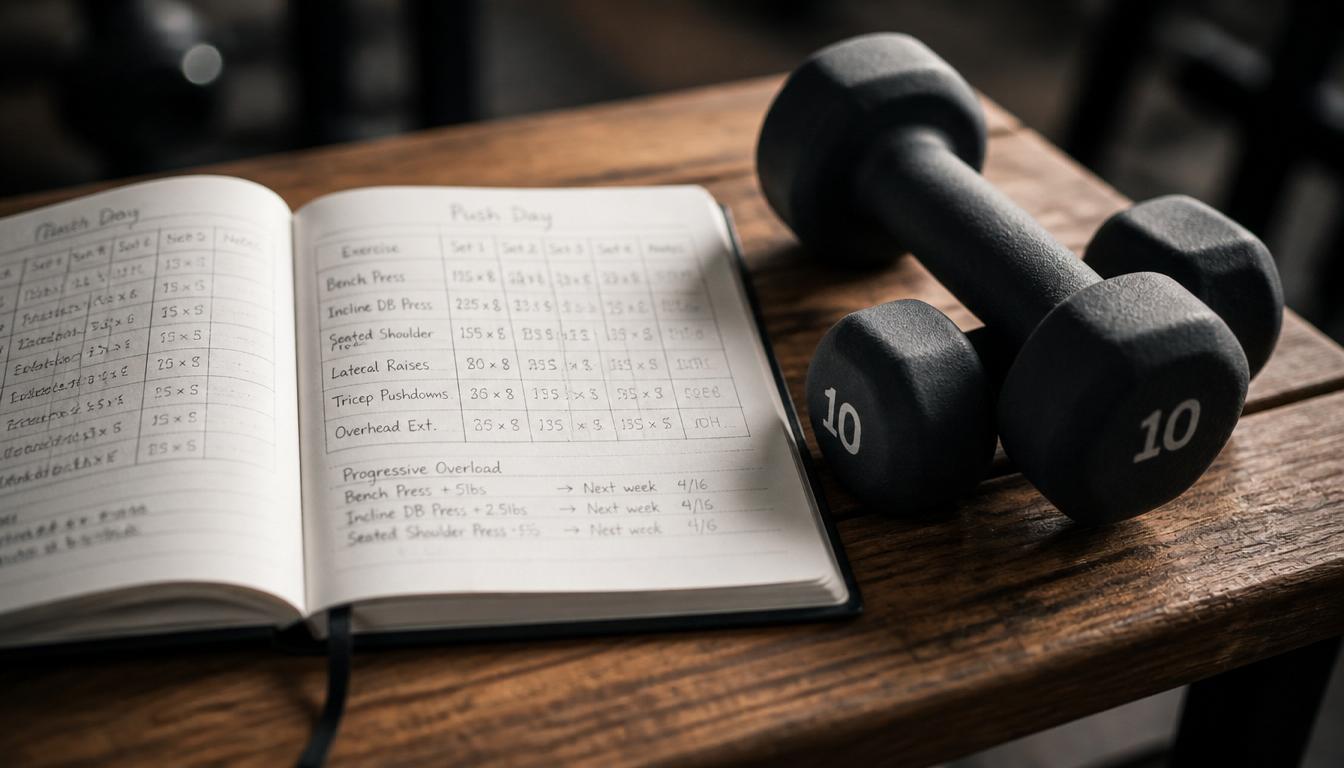
Understanding progressive overload principles for beginner fitness is the absolute foundation of long-term physical change. Progressive overload simply means gradually increasing the stress placed upon your musculoskeletal system over time so your body continues to adapt. For a beginner, this does not mean jumping to heavy weights right away; progression can take many subtle forms. You can achieve overload by performing one additional repetition with the same weight, improving your execution form, or slowing down the lowering phase of a lift. Decreasing your rest intervals slightly between sets or adding a small amount of resistance once you reach the top of a rep range are also powerful methods. Tracking every single workout in a dedicated notebook or smartphone app guarantees that you are holding yourself accountable to consistent growth. Without applying systematic progression, your body will quickly adapt to the workload and stall out, making structured tracking essential.
beginner strength training schedule
Creating a balanced beginner strength training schedule ensures that work and rest are perfectly integrated into your weekly lifestyle. A classic three-day split operating on non-consecutive days—such as Monday, Wednesday, and Friday—allows for a full 48 hours of recovery between intense training bouts. On off days like Tuesday and Thursday, incorporating 20 to 30 minutes of low-impact cardiovascular activity like brisk walking or stationary cycling supports active recovery and heart health. Weekends can be reserved for gentle mobility work, dynamic stretching, or complete physical rest to allow your central nervous system to reset. This structured cadence prevents chronic physical fatigue while making fitness a predictable, seamless part of your weekly routine. Consistency within this framework matters vastly more than hitting high intensity for a single week and dropping off. Adhering strictly to your planned rest days is just as vital for muscle repair and fat loss as the lifting sessions themselves.
fat loss and muscle building workout routine
Designing an effective fat loss and muscle building workout routine requires combining compound strength lifts with strategic metabolic output. Resistance training preserves lean muscle tissue while operating in a moderate calorie deficit, forcing your body to burn stored body fat for energy. When you recruit large muscle groups through movements like squats, deadlifts, and rows, your body expends significantly more energy during and after the workout. Prioritizing strength work over endless cardio keeps your metabolic rate elevated long after you leave the gym floor. Pairing full-body lifting sessions with 150 minutes of weekly moderate-intensity aerobic exercise optimizes overall cardiometabolic health. Adequate dietary protein intake works synergistically with this training approach to repair damaged muscle fibers and keep you full. Through this concurrent approach, you reshape your body composition safely without relying on crash diets or soul-crushing cardio routines.
injury prevention tips for gym beginners
Implementing smart injury prevention tips for gym beginners guarantees that your fitness journey remains uninterrupted by joint pain or setbacks. Always start every session with a 5 to 10-minute dynamic warm-up that raises core body temperature and mobilizes major joints. Exercises like arm circles, leg swings, hip openers, and cat-cows prepare your nervous system and lubricate your joints for heavier loads. During lifts, maintain a neutral spine, keep your core engaged, and focus on controlling the weight through a full range of motion rather than ego-lifting. Stop your sets one to two repetitions shy of absolute muscle failure to ensure mechanics never break down under fatigue. If you experience sharp or localized joint pain, immediately stop the exercise and modify the movement or lower the weight. Prioritizing post-workout hydration, quality sleep, and daily mobility work preserves your physical resilience for decades to come.
Master the Mental Game of Fitness Consistency
Physical training is ultimately a test of psychological habit formation and emotional discipline. The initial motivation you feel during your first week will naturally fade, which is why establishing automatic routines is crucial. Focus on process-oriented goals, such as completing three workouts per week, rather than fixating solely on scale weight or rapid visual changes. Recognize that progress is never strictly linear; some days will feel effortless, while others will feel like a grind. Celebrate small wins, such as adding five pounds to a lift or performing an extra push-up with clean technique. Surrounding yourself with supportive fitness communities or workout partners creates accountability when your willpower is low. By shifting your mindset from a temporary diet or fix to a permanent lifestyle upgrade, you build long-term health and vitality.

Summary
Starting your fitness journey with the best workout for beginners centers on simplicity, sustainable progression, and balanced recovery. By committing to a structured 3-day full-body strength program—whether at the gym or through an easy bodyweight routine at home—you stimulate all major muscle groups while giving your joints ample time to adapt. Emphasizing proper technique, tracking progressive overload, and integrating low-impact cardio ensures safe fat loss and muscular strength development. Consistency always triumphs over intensity, making regular, manageable efforts the true secret to long-term health transformation.
How to Start Exercising from Scratch: The Complete Beginner’s Guide to Building a Strong, Healthy Body
Frequently Asked Questions (FAQ)
1. How many days a week should a beginner work out?
A beginner should ideally perform strength training 3 days per week on non-consecutive days (e.g., Monday, Wednesday, Friday). This structure provides enough stimulus for muscle growth while allowing 48 hours between sessions for complete recovery.
2. Can I build muscle and lose fat at home without equipment?
Yes! Bodyweight exercises like push-ups, squats, glute bridges, and doorframe rows provide enough tension to build baseline muscle and burn calories, especially for beginners.
3. How do I know when to increase the weight or difficulty?
Apply progressive overload: once you can comfortably complete the upper rep target (e.g., 12 reps) across all sets with proper form, increase the weight by 2.5 to 5 pounds or choose a harder exercise variation.
4. Should I do cardio before or after my strength workout?
It is best to perform strength training first when your energy levels and focus are highest, followed by moderate cardio at the end or on off days. This prevents fatigue from affecting your lifting mechanics.
5. What should I do if I am extremely sore after my first workout?
Mild muscle soreness (DOMS) is completely normal for beginners. Perform light walking, active stretching, stay hydrated, and ensure you get adequate sleep; avoid intense workouts until acute pain subsides.
Call to Action (CTA)
Ready to take control of your physical health and transform your strength without the guesswork? Download our free Beginner 30-Day Workout Tracker today to easily log your reps, track progressive overload, and stay consistent on your journey to a stronger, healthier body!